One Piece of Content Can Do More Than You Think: How to Get More Mileage Out of Your Marketing
If you have ever sat down to write a social media post and thought, “What in the world am I supposed to post today?” you are definitely not alone.
Content creation can feel exhausting, especially for small business owners who are already juggling customers, staff, scheduling, invoices, operations, and everything else that comes with running a business.
Many business owners think they need a brand-new idea every time they post online, send an email, write a blog, or update their website. That mindset can quickly lead to burnout.
The truth is, strong marketing does not always require more ideas.
Sometimes, it requires using one good idea more strategically.
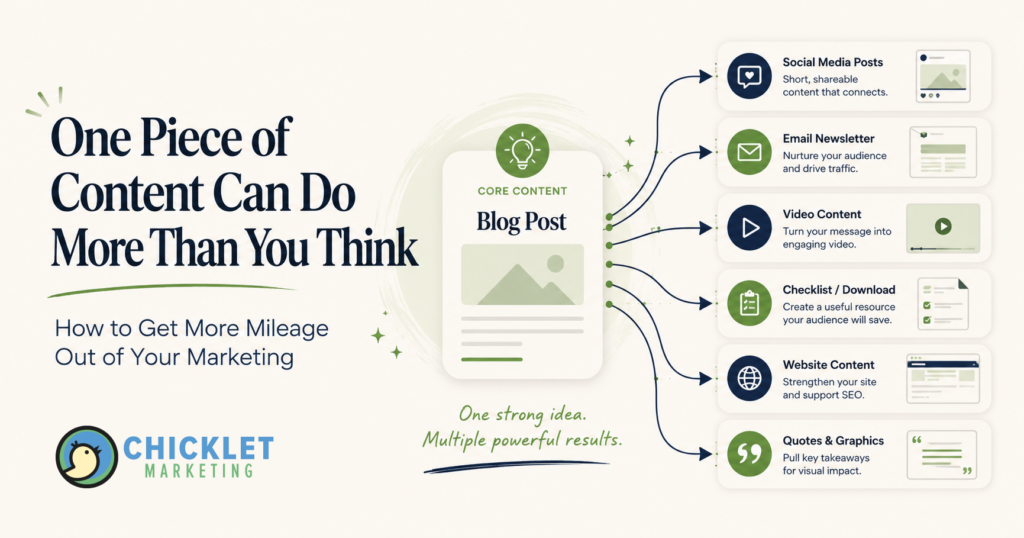
One well-thought-out piece of content can often become several social media posts, an email newsletter topic, a blog article, a video idea, a printed handout, a sales conversation, or even a frequently asked question on your website.
That is where content repurposing comes in.
What Is Content Repurposing?
Content repurposing means taking one core idea and reshaping it into multiple pieces of marketing content.
Instead of creating everything from scratch, you start with one strong topic and use it in different ways across different platforms.
For example, one blog post could become:
- Several social media captions
- A short email newsletter feature
- A carousel post
- A video script
- A checklist
- A website FAQ
- A printed flyer or handout
- A sales talking point
- A Google Business Profile update
The message stays connected, but the format changes.
This helps you stay consistent without constantly reinventing the wheel.
Why This Matters for Small Businesses
Small business owners rarely have unlimited time, unlimited budgets, or an in-house marketing department.
That means every piece of content needs to work harder.
When you create one blog post and only post it once, you may be missing opportunities to extend its value. But when you use that same topic across your social media, email marketing, website, and customer conversations, you create more visibility with less stress.
Repurposing content helps your business:
- Stay consistent online
- Save time
- Reinforce important messages
- Improve brand recognition
- Support SEO
- Educate your audience
- Create more value from each idea
- Avoid the “what do we post?” panic
And perhaps most importantly, it helps your marketing feel more connected.
When your website, social media, email newsletters, and other materials are all working from the same core message, your audience hears that message more than once. That repetition builds familiarity, and familiarity helps build trust.
Start with a Strong Core Topic
The best repurposed content starts with one strong, useful idea.
This might be a question customers ask often, a service you want people to understand better, a common mistake you see in your industry, or a helpful tip that would make life easier for your audience.
For Chicklet Marketing, examples might include:
- Why website hosting matters
- How to know when your website needs a refresh
- Why consistent social media builds trust
- How branding affects first impressions
- What small businesses should know about email newsletters
- How to recognize fraudulent emails
- Why clearing your browser cache matters when reviewing website updates
For another business, the topic will look different. A home services company might talk about seasonal maintenance. A realtor might explain what buyers should prepare before touring homes. A nonprofit might highlight volunteer impact. A financial professional might explain a common planning question.
The key is to choose something your audience actually cares about.
A strong core topic should be helpful, specific, and connected to the services you provide.
Turn One Blog Post Into Multiple Social Media Posts
A blog post is one of the best starting points for repurposing content because it gives you room to explain a topic in detail.
Once the blog is written, you can pull out smaller points and turn them into social media posts.
For example, if you write a blog about clearing browser cache, you could create social posts like:
- What is browser cache?
- Why your website may still show old updates
- How to do a hard refresh
- When to clear cache
- Cache vs. cookies
- Why website updates may look different on different devices
Each of those points can become its own post.
This gives you multiple pieces of content from one larger idea, and each post leads people back to the main blog if they want more detail.
Turn a Blog Topic Into an Email Newsletter
Your email newsletter does not always need to be completely separate from your blog. In fact, your blog content can give your newsletter a clear direction.
Instead of writing a brand-new email from scratch, use the blog as your featured topic.
You can include:
- A short introduction
- A few key takeaways
- A link to the full blog post
- A related marketing tip
- A soft call-to-action
This makes your newsletter more valuable because you are not just saying, “Here is what we do.” You are giving your audience helpful information they can use.
It also helps drive traffic back to your website.
Turn Customer Questions Into Content
One of the easiest ways to find content ideas is to pay attention to the questions customers already ask.
If one person asks a question, there is a good chance someone else is wondering the same thing.
Common questions can become:
- Blog posts
- Social media posts
- Email newsletter topics
- FAQ sections
- Short videos
- Graphics
- Client handouts
For example, if clients often ask why their website updates are not showing right away, that is a perfect content topic. You can explain browser cache, provide instructions, and then use that blog as a resource whenever the question comes up again.
That is content working for your business.
Instead of answering the same question repeatedly from scratch, you now have a helpful resource ready to send.
Use One Idea in Different Formats
People consume content differently.
Some people like reading blog posts. Others prefer quick social media tips. Some respond better to visuals. Others may open an email but never click through to a blog unless the topic catches their attention.
Repurposing allows you to meet people where they are.
One idea could become:
- A written blog for your website
- A short caption for Facebook
- A graphic tip for Instagram
- A professional post for LinkedIn
- A quick email newsletter feature
- A checklist PDF
- A short video script
You are not repeating yourself in a lazy way. You are reinforcing a helpful message in different formats.
That is smart marketing.
Repurposing Does Not Mean Copying and Pasting Everywhere
It is important to note that repurposing does not mean posting the exact same thing in every place.
Each platform has a different purpose.
A blog post can be more detailed. A social media post should be more concise and attention-grabbing. An email newsletter should feel more personal and direct. A video script should sound natural when spoken.
The core message can stay the same, but the delivery should fit the platform.
For example, a blog may explain a topic in 900 words. A social media post may highlight one practical takeaway. An email may summarize the idea and invite readers to learn more.
Same topic. Different format. Stronger reach.
Build a Content Library Over Time
When you start repurposing content, you also start building a content library.
This is incredibly valuable for small businesses.
Over time, your business can collect:
- Blog posts that answer common questions
- Social media graphics that can be updated and reused
- Newsletter topics that can be refreshed seasonally
- Service explanations that can support sales conversations
- Website resources that improve SEO
- Educational content that builds trust
Instead of starting from zero each month, you have a foundation to build from.
This makes marketing more efficient and more consistent.
Consistency Becomes Easier When You Have a System
One of the biggest challenges in marketing is consistency.
It is easy to show up online when things are slow. It is much harder when business gets busy.
That is why having a system matters.
When you build content around strong core topics, you are less likely to run out of ideas. You can plan ahead, create related pieces, and keep your marketing moving even during busier seasons.
A simple content system might look like this:
- Choose one helpful topic for the month.
- Write one blog post or longer-form piece.
- Pull out 4 to 6 smaller points for social media.
- Feature the topic in your email newsletter.
- Create one graphic or video connected to the topic.
- Save the content so it can be reused or refreshed later.
That system turns one idea into a full month of useful marketing.
Strong Content Supports Trust
At the end of the day, content is not just about filling space online.
It is about building trust.
When your business consistently shares helpful, relevant, and thoughtful content, people begin to see you as a reliable resource. They understand what you do. They learn how you think. They see the value you bring before they ever reach out.
That kind of trust matters.
People are more likely to contact a business that has already helped them understand something, answered a question, or made them feel more confident.
Content does not need to be complicated to be effective. It needs to be clear, consistent, and useful.
Final Thoughts
You do not need a brand-new idea every time you sit down to market your business.
You need strong ideas that can work harder.
One helpful blog post can become social media content, newsletter content, website content, sales support, and client education. One customer question can become a resource you use again and again. One clear message can show up across platforms and help your audience remember what you do and why it matters.
That is the power of content repurposing.
At Chicklet Marketing, we help small businesses create marketing that feels connected, consistent, and built to support real growth. From websites and blogs to social media, newsletters, branding, and print materials, we believe your content should work together, not live in disconnected pieces.
Because good marketing is not always about doing more.
Sometimes, it is about making what you already have work smarter.